Achilles Tendonitis Treatment San Diego: The Calf Dysfunction Pathway
In this blog post and video, I dive deep into the frustrating issue of Achilles tendonitis, particularly focusing on a common pattern I see in distance runners known as the calf dysfunction pathway. I explain how the pain often stems from a breakdown in the tendon, leading to a vicious cycle of discomfort that traditional rest and stretching advice fails to resolve. We explore how your movement mechanics can overload the Achilles and identify upstream issues like weak glutes or ankle restrictions that contribute to the problem. My key takeaway is that the pain in your Achilles is just a symptom of a larger issue, and I encourage you to seek a thorough assessment from a skilled practitioner to address the root causes. Remember, true recovery involves treating the entire system, not just the symptom.
⏱️ TIMESTAMPS:
0:00 - Introduction: The Frustrating Achilles Pain Cycle
1:09 - Part 1: Inside the Degenerating Tendon (Tendinosis vs. Tendinitis)
2:31 - Part 2: How Your Gait Overloads the Achilles (The Three Rockers)
3:34 - Part 3: Identifying the Real Culprits (Ankle Restrictions, Weak Glutes)
4:22 - Part 4: Bridging West and East (Posterior Chain = Bladder Channel)
5:25 - Part 5: Treating the System, Not the Symptom
6:32 - Part 6: Key Takeaways
Inside the Degenerating Tendon 1:41
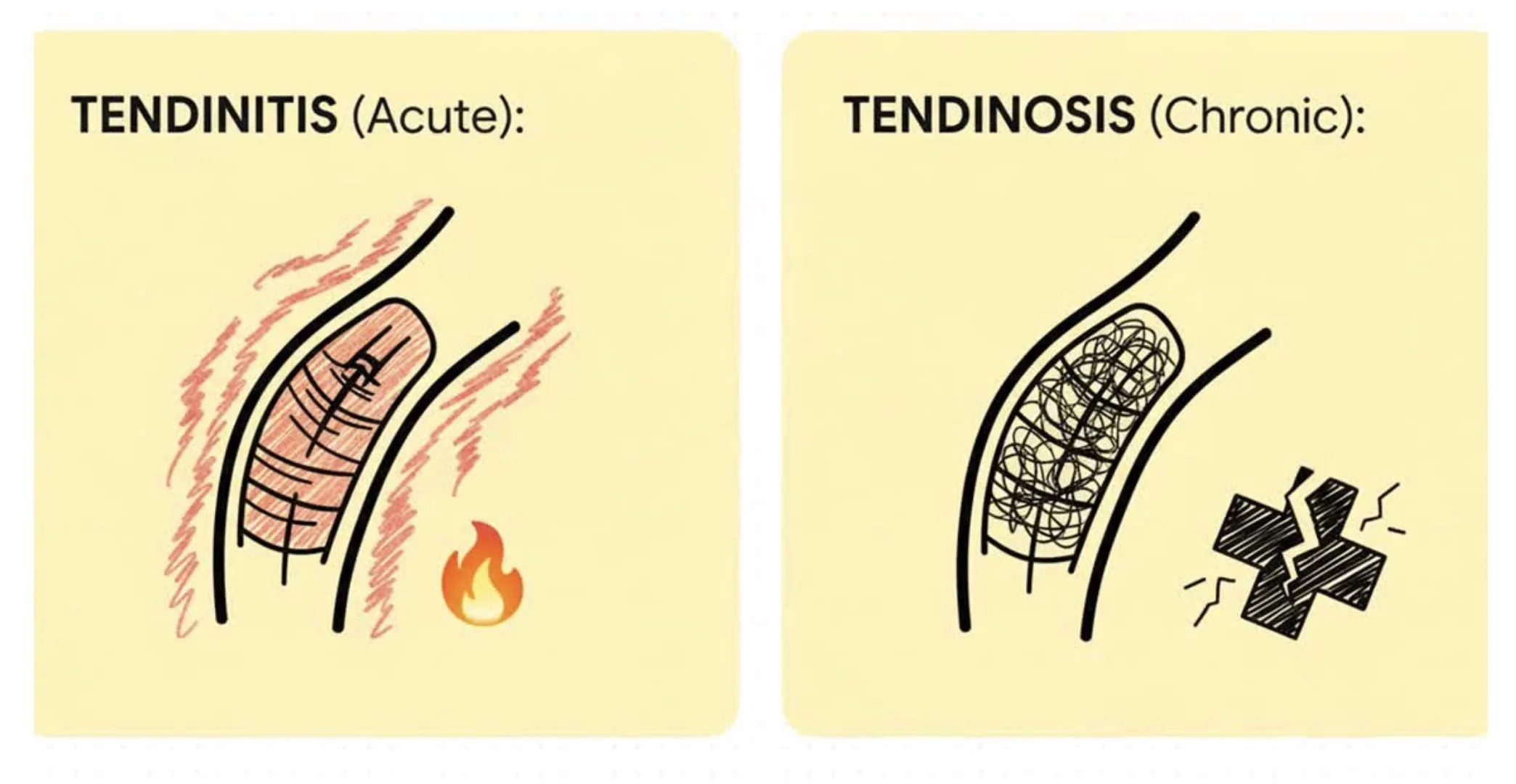
Chronic Achilles pain isn't tendinitis (inflammation)—it's tendinosis, where the healing process has failed and tissue is actively degenerating. Here's what's happening at the cellular level:
Tissue becomes dehydrated and stiff with disorganized scar formation
New defective blood vessels grow that leak fluid and create internal pressure
New hypersensitive nerve branches develop alongside vessels
Result: a tendon that's weaker, less flexible, and has pain volume turned way up
Rest doesn't fix the underlying tissue breakdown—it just temporarily reduces symptoms
Understanding this distinction changes everything about treatment approach.
How Your Gait Overloads the Achilles 2:31
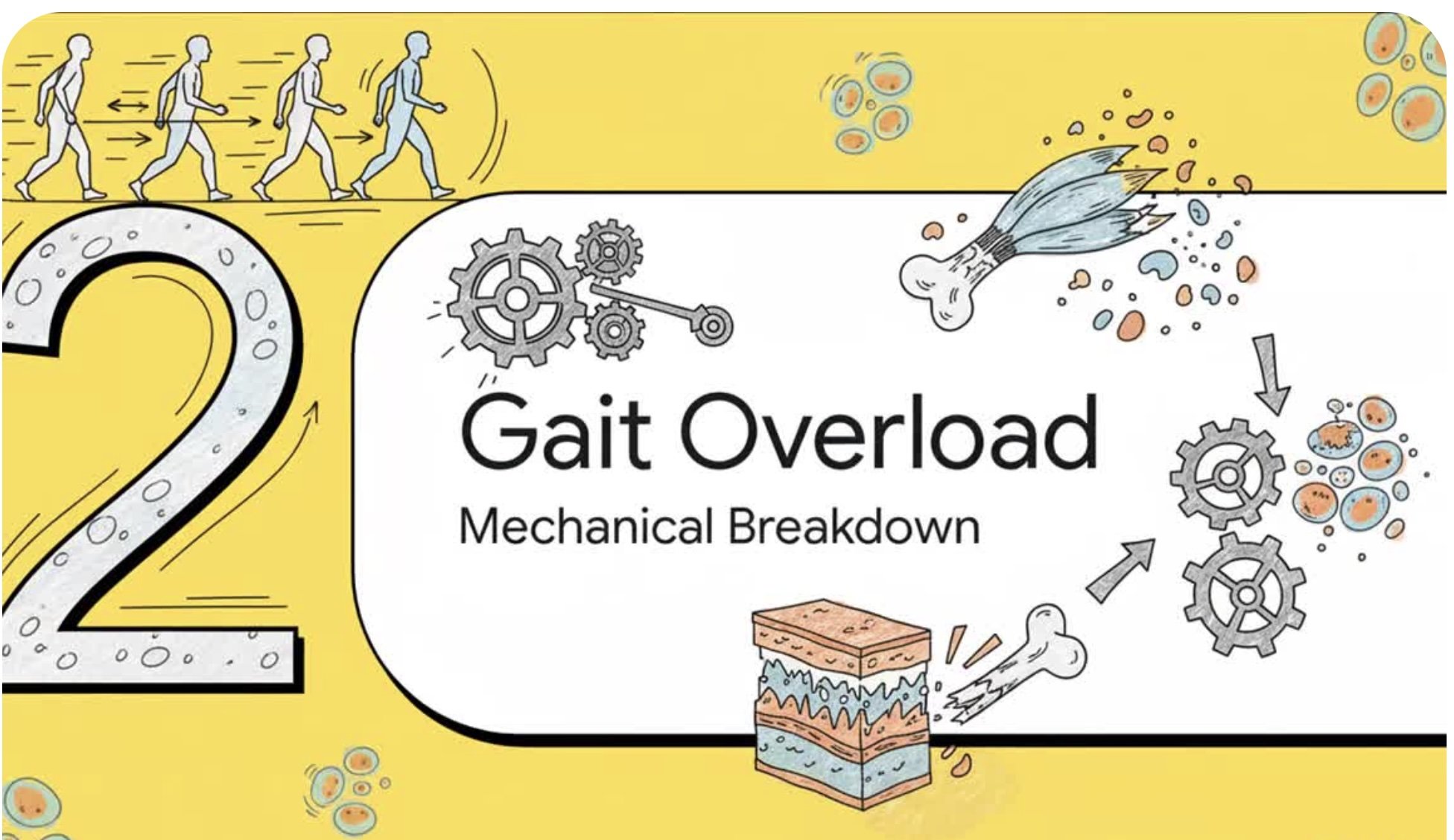
Efficient running requires three smooth "rockers"—heel rocker (impact absorption), ankle rocker (tibia pivots forward), and forefoot-toe rocker (powerful push-off). When the ankle rocker gets jammed and can't move freely, your body compensates by forcing your calves to work overtime:
Limited ankle dorsiflexion creates compensatory eccentric calf contraction with every step
Your calf complex acts like emergency brakes, slamming on with each stride
All that repetitive force channels directly into your Achilles tendon
The problem isn't in the calf itself—it's upstream (ankle restriction) or downstream (weak glutes)
Your Achilles pain is the symptom. Poor mechanics are the cause.
The Real Culprits: Ankle and Hip Dysfunction 3:34
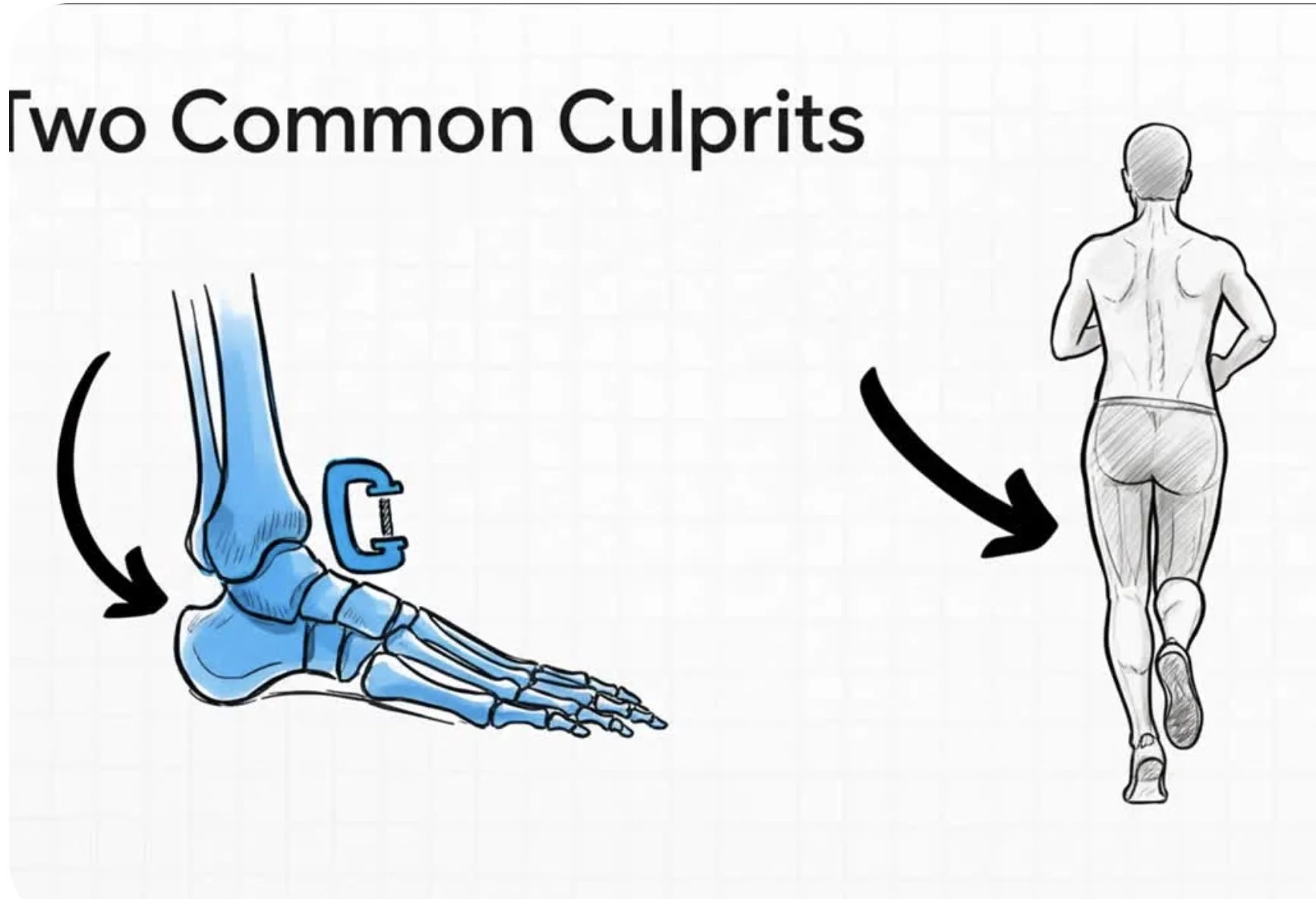
Two upstream dysfunctions typically drive calf overload and Achilles breakdown:
Ankle restriction: A stuck midfoot bone (often the cuboid) jams up ankle dorsiflexion mechanics
Weak glutes: If your hips can't extend powerfully to propel you forward, your calves compensate by doing propulsion work they're not designed for
Proprioception loss: Your calf isn't just a motor—it's a sophisticated sensory organ coordinating knee-ankle timing; chronic overload disrupts this entire system
The calf dysfunction pathway explains why treating only the Achilles rarely works—you're not addressing what caused the overload in the first place.
Ready to identify YOUR specific pattern? I offer complimentary 15-minute assessments where we can analyze your gait, test ankle mechanics, and map the exact compensation pattern driving your Achilles pain. Schedule here: www.bookacu.com
Which Pattern Is Driving YOUR Achilles Pain?
Now that you understand the two primary upstream causes—ankle restriction and weak glutes—the next question is: which one applies to you? Or is it both?
I've created this quick self-assessment to help you identify your likely compensation pattern. Answer 8 questions about your symptoms, movement, and training response, and you'll receive a personalized result indicating whether your Achilles overload is more likely driven by ankle mechanics, glute weakness, or a combination of both.
This isn't a diagnosis—it's a starting point for understanding your body's patterns.
Bridging West and East: The Posterior Chain 4:22
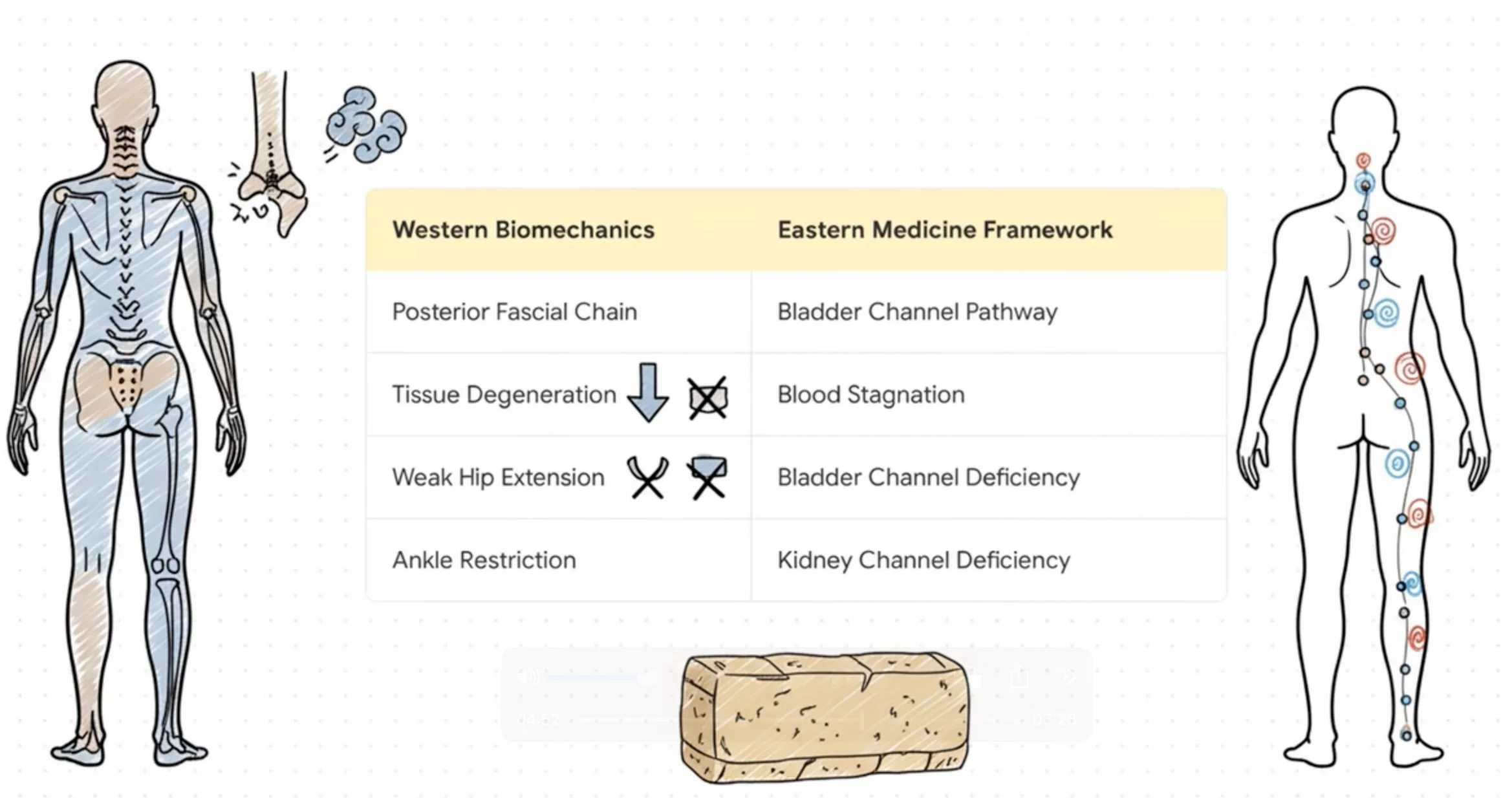
What modern biomechanics calls the posterior fascial chain—that interconnected web up the back of your body—Eastern medicine has called the Bladder channel for centuries:
Tissue degeneration = Blood stagnation (healing resources can't reach where they're needed)
Weak glutes that can't propel you forward = Bladder channel deficiency
Stuck ankle mechanics = Kidney channel deficiency
The Bladder channel pathway IS the anatomical highway from foot to glutes
This isn't mystical energy—it's an ancient map describing the same physical, functional system modern research now validates. Two different languages describing the exact same dysfunction.
Treating the System, Not the Symptom 5:25
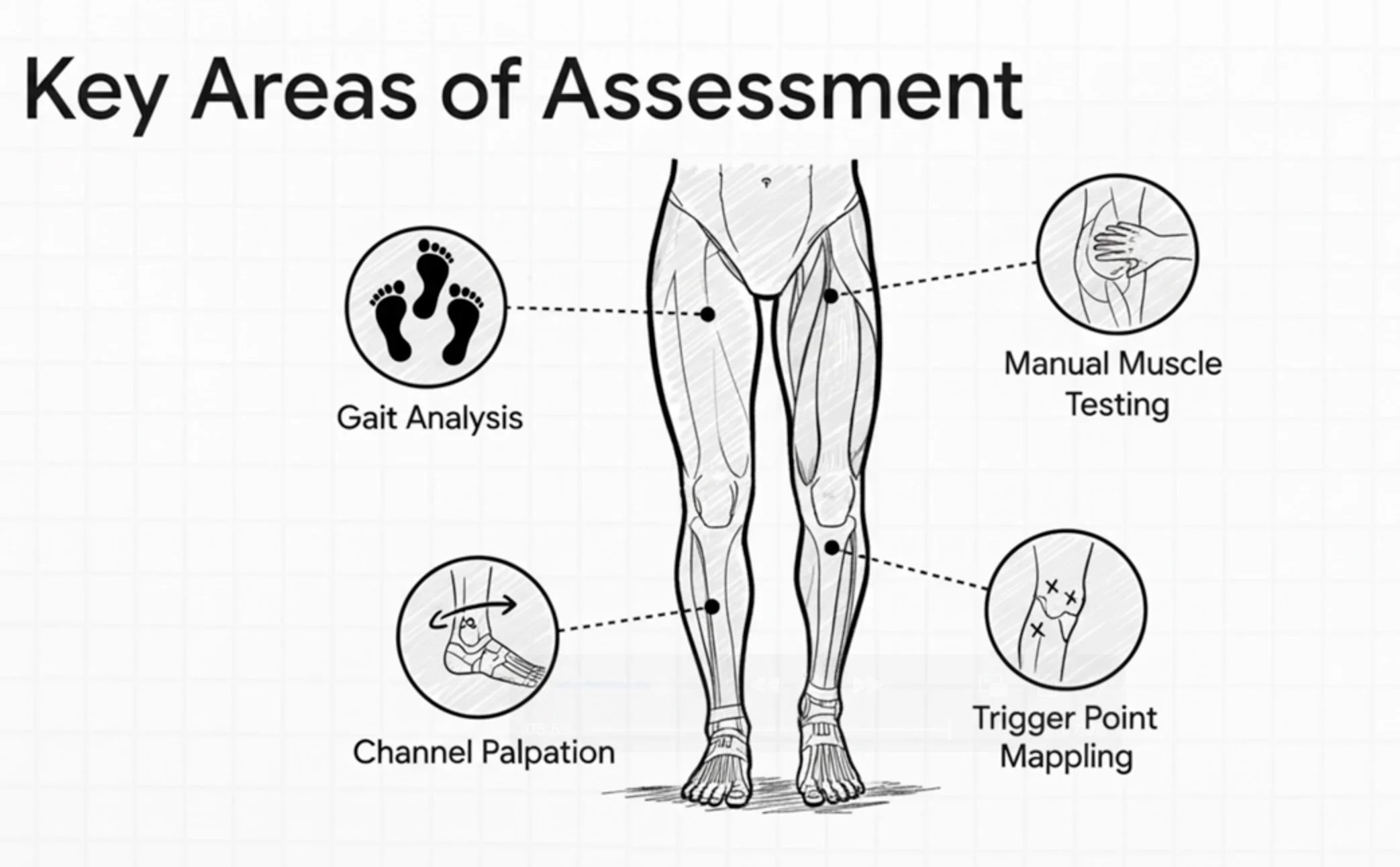
Effective treatment requires comprehensive assessment to find YOUR specific compensation pattern—gait analysis, muscle testing, trigger point mapping, ankle mobility checks, and channel palpation along the entire posterior chain.
Recovery happens in stages (timeline varies by individual):
Stage 1 (Relieve): Reduce acute pain, release trigger points, calm inflammation
Stage 2 (Restore): Fix root causes—restore ankle mobility, retrain motor patterns, strengthen glutes, improve tissue quality; motor retraining takes time and varies based on chronicity
Stage 3 (Elevate): Build resilience through maintenance so the problem doesn't return with training increases
The pain in your Achilles is just the messenger. Real recovery comes from fixing the upstream problems—restoring ankle mechanics, retraining calf coordination, and strengthening your posterior chain from foot to glutes.
Questions about what's causing YOUR Achilles pain? Let's discuss your specific situation in a complimentary assessment.
Achilles Tendonitis Treatment San Diego: The Calf Dysfunction Pathway
That first step out of bed in the morning is a familiar, sharp warning sign for any distance runner dealing with Achilles pain. You hobble to the kitchen, it loosens up, and you might even feel okay for the first couple of miles of your run. But then, inevitably, around mile four, that familiar, deep ache returns, tightening with every stride. It's a frustrating cycle: you rest, you stretch your calves religiously, the pain subsides, and you head back out, only for the injury to reappear, threatening to derail your entire training block.
The reason this standard "rest and stretch" approach so often fails is that it misses the point. Chronic Achilles pain is rarely a simple problem of inflammation in the tendon. More often, the tendon is just the messenger—the check engine light on your body's dashboard. The Achilles is the thickest, strongest tendon in your body; it shouldn't break down from normal running. When it does, it's a critical signal that something upstream is broken. For athletes seeking achilles tendonitis treatment in San Diego, understanding this calf dysfunction pathway is essential. This article will explore one of the most common, yet often overlooked, root causes I see in my sports medicine acupuncture practice: a biomechanical pattern that creates downstream tendon breakdown.
We'll break down why your chronic pain isn't tendinitis but rather a state of tissue failure called tendinosis. We'll explore how faulty gait mechanics overload the tendon, trace the problem to its true origins in your foot and glutes, and bridge the gap between Western biomechanics and Eastern medicine to show how acupuncture for achilles tendonitis addresses the complete system. Finally, we'll outline what a modern assessment and integrated treatment approach looks like at my San Diego practice, providing a roadmap for lasting recovery.
Understanding Achilles Tendonitis vs. Tendinosis: Why Acupuncture Addresses Tissue Degeneration
When athletes talk about "tendonitis" or "tendinitis," they're usually referring to any pain in a tendon. However, it's crucial to differentiate between two distinct conditions, because the chronic, nagging Achilles pain that plagues runners in San Diego is rarely a simple case of acute inflammation.
Tendinitis is the acute inflammatory phase. It's a normal and necessary healing response to stress, characterized by swelling and increased metabolic rate as your body rushes resources to the area.
Tendinosis is what happens when that stress persists and the healing process fails. It is a state of chronic tissue degeneration. The tendon's internal structure fundamentally changes, marked by decreased internal bound water (making it dehydrated and stiff), anarchic scar tissue formation, the growth of defective new blood vessels that leak, and the development of new, hypersensitive nerve branches.
Essentially, tendinosis is a "failed healing response" or, more accurately, tissue failure. This is why rest alone is so often ineffective for chronic achilles tendonitis. Rest might calm the irritation, but it does nothing to fix the degraded, disorganized tissue or the underlying mechanical problem that caused the overload in the first place.
In my San Diego sports medicine acupuncture practice, I see this pattern appear most commonly around weeks 10-14 of marathon training when mileage peaks and long runs cross 13-16 miles. The body's compensation patterns can no longer keep up, and the Achilles becomes the weak link that finally breaks down. Acupuncture for achilles tendinosis addresses both the tissue quality issues and the mechanical dysfunction—not just symptom management, but solving the underlying puzzle.
The Calf Dysfunction Pathway: How Faulty Gait Mechanics Create Achilles Tendonitis
Efficient running is a fluid sequence of movements managed by three "rockers" of gait, which allow your body's momentum to roll smoothly over your foot: the Heel Rocker, the Ankle Rocker, and the Forefoot-Toe Rocker.
The point of failure for many runners with achilles tendinitis occurs during the Ankle Rocker. This is the critical phase where your tibia (shin bone) must pivot smoothly forward over your foot, a motion known as dorsiflexion. When ankle dorsiflexion is limited, your body has to find a way to keep moving forward. The most common compensation is an excessive eccentric contraction of the calf muscles (the gastrocnemius and soleus). Eccentric means the muscle is lengthening while under tension—the most demanding type of contraction.
Instead of allowing a smooth forward pivot, the calf complex has to slam on the "emergency brakes" with every single step to control the restricted motion. This constant, repetitive braking action overloads the calf muscles, channeling massive amounts of excessive force directly down into the Achilles tendon. Over thousands of steps, this compensatory overload is what creates the tissue degeneration and failed healing state of tendinosis.
When treating achilles tendonitis in San Diego, understanding this gait dysfunction is crucial. Sports medicine acupuncture addresses the overloaded calf muscles through motor point needling—retraining the neuromuscular patterns that create this compensation cycle.
Upstream Causes: Why Achilles Tendonitis Often Starts in Your Foot or Glutes
When it comes to chronic running injuries, the pain is downstream, but the problem is almost always upstream. The overloaded calves and painful Achilles are the victims, not the culprits. While there can be other causes, including neural referral from the spine (such as L5-S1 Spondylosis), two upstream drivers of the Calf Dysfunction Pathway show up repeatedly in athletes I treat for achilles pain in San Diego.
Cause 1: Ankle & Foot Restriction
Limited ankle dorsiflexion isn't always because of "tight calves." A pattern I see repeatedly in San Diego runners is a restriction in the small bones of the foot itself. A very common finding is a cuboid bone—a small bone on the outside of your midfoot—that gets "stuck" in a supinated (rolled out) position. For your tibia to move forward properly during the Ankle Rocker, your foot must be able to pronate (roll in). A stuck cuboid blocks this necessary motion, creating a bony traffic jam that forces the calf to compensate.
Cause 2: Weak Glutes
Your body is connected by a continuous band of tissue called the posterior fascial chain. In Eastern medicine, this exact anatomical highway has been mapped for centuries as the Bladder Channel. It runs from the bottom of your feet, up your calves and hamstrings, and into your glutes. The glutes are the primary engine for powerful hip extension, which propels you forward. If the glutes are weak or not firing correctly, the body shifts propulsive force down the chain to the calves. This forces the calves to do propulsive work they aren't designed for, creating a massive overload that feeds directly into the Achilles.
Adding another layer, the calf complex—particularly the thin plantaris muscle—is also a sophisticated sensory organ. It is loaded with muscle spindles that provide real-time data to your central nervous system about knee position, allowing the larger calf muscles to "know" exactly when to fire. Chronic overload disrupts this vital neuromuscular coordination, leading to mistimed muscle firing and further abnormal loading of the Achilles.
In my San Diego practice treating achilles tendinitis with acupuncture, identifying which upstream dysfunction is driving your specific pattern is the first step. Motor point testing of the glutes and ankle mobility assessment reveal the root cause.
An Eastern Medicine View: How Acupuncture Maps Achilles Tendonitis Through Bladder and Kidney Channels
While Western biomechanics gives us a precise language for muscles, bones, and forces, Eastern medicine offers a framework that has been mapping these exact functional relationships for centuries. When providing achilles tendonitis acupuncture treatment in San Diego, I use both perspectives simultaneously—it's not a different reality; it's just a different map of the same territory.
The Bladder channel runs down the entire back of the body, from the head, down the spine, through the glutes, and along the posterior leg to the outside of the foot. This isn't mystical—the Bladder channel pathway IS the posterior fascial chain described in Western anatomy. Motor points along the gastrocnemius and soleus ARE Bladder channel points.
The Kidney channel is said to govern the health and quality of the tendons. A "Kidney channel deficiency" manifests as poor tissue quality—tendons that are dry, brittle, and prone to degeneration. This mirrors the Western understanding of chronic tendinosis as tissue dehydration and poor collagen integrity.
For athletes dealing with chronic achilles tendonitis in San Diego, acupuncture's unique value is this dual perspective. We're not choosing between Western or Eastern medicine—we're integrating both for comprehensive treatment.
The East-West Bridge: How Acupuncture Addresses Both Biomechanics and Channel Imbalance
Integrating these two perspectives provides a complete diagnostic picture. What Western science observes in the lab, Eastern medicine has been mapping on the body for millennia. Here is how sports medicine acupuncture for achilles tendinitis in San Diego uses both maps:
Tendon Degeneration (Tendinosis):
A Western diagnosis of dehydrated, scarred tissue with poor collagen integrity is what Eastern medicine calls a combination of Blood Stagnation (impeded circulation and nourishment) and Kidney Channel Deficiency (poor intrinsic tissue quality).
Weak Posterior Chain:
Western biomechanics identifies weak glutes forcing calf compensation. Eastern medicine describes this as Bladder Channel Deficiency in the upper part of the channel, creating an overload in the lower part.
Calf Overload from Ankle Restriction:
Western mechanics sees a bony block forcing calf muscles to work eccentrically. The channel diagnosis is Bladder Channel Excess in the calves (overworked) caused by Kidney Channel Deficiency at the ankle (poor joint mechanics and weak stabilizers).
These aren't competing theories; they are complementary views that, when combined, lead to a more comprehensive and effective treatment strategy for achilles pain. This is what makes acupuncture for achilles tendonitis effective—we address the complete system, not just the symptom.
Sports Medicine Acupuncture for Achilles Tendonitis: What Assessment and Treatment Looks Like
Before any needles go in, I'm doing detective work. A successful treatment plan for Achilles pain depends on a thorough assessment to identify your specific compensation pattern. Each runner's history and mechanics are unique, so achilles tendonitis acupuncture treatment must be tailored precisely to what we find.
My assessment process for achilles tendinitis in San Diego integrates both Western and Eastern diagnostic methods:
Gait Analysis: I watch you walk and run to observe the three rockers, your foot progression angle, and your push-off mechanics.
Manual Muscle Testing: I test the strength and activation quality of your gastrocnemius, soleus, and glute muscles to find the weak links in the chain.
Trigger Point Mapping: I carefully palpate the calf muscles. I can often reproduce your exact Achilles pain by pressing on trigger points in your calf—that moment of recognition tells us the pain is referred from the muscle, not originating in the tendon itself.
Ankle Mechanics Testing: I check your ankle's range of motion, specifically dorsiflexion, and assess the mobility of key bones like the cuboid.
Channel Palpation: Along the Bladder and Kidney channel pathways, I'm feeling for areas of excess (tight, tender, overactive) and deficiency (weak, empty, underactive).
Based on these findings, an integrated sports medicine acupuncture treatment plan is designed where every needle has a specific neurological purpose. This isn't woo-woo—it's precise neuromuscular therapy guided by channel theory.
Local Achilles Points: Needles are placed at points like UB60 (Kunlun) and KI3 (Taixi) around the ankle to clear Blood Stagnation and nourish the tendon tissue.
Motor Point Needling: This is a cornerstone of achilles tendonitis treatment with acupuncture in San Diego. Needles are inserted into the motor points of the calf muscles—where the nerve enters—often with electrical stimulation. This is for neuromuscular re-education, designed to retrain firing patterns and restore proper control. I can see and feel the muscle response change in real-time as firing patterns normalize.
Trigger Point Release: Needles are used to deactivate trigger points in the calf that are referring pain down to the Achilles. This releases the fascial restrictions creating abnormal tension on the tendon.
Distal Points: To address the root cause, needles are placed on the Bladder channel at the glutes (UB54, UB40) to strengthen hip extension and take the propulsive burden off the calves. Kidney channel points (KI7, KI3) tonify tendon quality systemically.
Care progresses through distinct stages, and the timeline varies for every athlete based on chronicity, training load, and individual healing capacity:
Stage 1 (Relieve): The initial focus is on reducing pain and calming the "angry," reactive tissue by releasing trigger points and improving local circulation. Early in treatment, you'll notice the sharp morning pain decreases and walking feels easier.
Stage 2 (Restore): This is where we address the root cause. Treatment focuses on retraining motor patterns through motor point acupuncture with e-stim, mobilizing the foot and ankle, and rebalancing the entire posterior chain from foot to glutes. Restoring proper neuromuscular function takes time and consistency—motor retraining varies based on how long you've had the compensation pattern.
Stage 3 (Elevate): Once function is restored, the focus shifts to maintenance and prevention, helping you stay healthy as you increase your training load. Monthly tune-ups catch early imbalances before they become problems.
Prevention and Smarter Training: Listening to the Early Warnings
The best time to seek achilles tendonitis treatment in San Diego is not when you're in severe pain, but when the very first signs appear. For many runners, this prevention window opens around weeks 10-14 of a training block. I use these concepts in my own marathon training—when I feel Achilles tightness starting, I immediately check my ankle dorsiflexion and treat my Bladder channel before it becomes a real problem.
Here are some actionable tips for preventing achilles tendinitis:
Avoid aggressive jumps in training mileage; respect the 10% rule.
Make ankle mobility exercises a non-negotiable part of your routine.
Strengthen your glutes with targeted activation work before they become a weak link.
Pay close attention to these early warning signs that suggest you should seek achilles pain treatment:
Morning stiffness in the Achilles that loosens up after a few minutes.
A familiar, predictable tightness that appears around mile 4-6 of a run.
A feeling of having a weak or inefficient push-off.
-
The most common cause I see in my San Diego practice is the calf dysfunction pathway. This happens when restricted ankle mechanics (often a stuck cuboid bone in your midfoot) or weak glutes force your calf muscles to work overtime with every step. Instead of smooth ankle dorsiflexion, your calves have to "slam on the brakes" repeatedly, channeling excessive force into the Achilles tendon. Over thousands of steps, this compensatory overload creates tissue degeneration.
-
Tendinitis (acute inflammation) is less common than most people think. What runners typically experience is tendinosis—chronic tissue degeneration where the healing process has failed. The tendon becomes dehydrated, fills with disorganized scar tissue, develops defective blood vessels, and grows hypersensitive nerve branches. This is why rest alone doesn't work—it doesn't fix the degraded tissue or the upstream mechanics causing the overload.
-
Sports medicine acupuncture addresses the complete system: tissue quality (through Kidney channel points that nourish tendons), neuromuscular dysfunction (through motor point needling with e-stim to retrain calf firing patterns), trigger point referral (releasing fascial restrictions in the calf), and the entire posterior chain from foot to glutes (through Bladder channel treatment). This isn't either/or—many athletes combine acupuncture with PT for comprehensive care.
-
Timeline varies significantly based on how long you've had the condition, your training load, and your body's adaptation speed. Treatment progresses through three stages: Relieve (pain reduction and trigger point release), Restore (motor retraining, ankle mobilization, posterior chain balancing—this takes time as neuromuscular patterns retrain), and Elevate (maintenance to prevent recurrence). If you catch it early when it's just mild tightness, you'll progress faster. Chronic tendinosis that's been building for months requires more time to address both tissue quality and motor dysfunction.
-
If rest and stretching haven't resolved your achilles pain, it's likely because the problem is upstream—not in the tendon itself. The pain is downstream; the dysfunction is in your ankle mechanics or glutes forcing calf compensation. I offer complimentary 15-minute assessments at my San Diego practice where we can perform gait analysis, muscle testing, trigger point mapping, and channel diagnosis to identify YOUR specific compensation pattern. From there, we create a treatment plan that addresses the root cause, not just the symptom.
Your Path Forward: Achilles Tendonitis Acupuncture in San Diego
Chronic Achilles pain is rarely an isolated problem with your tendon. It is a symptom of a larger system breakdown—the Calf Dysfunction Pathway. This pattern shows how upstream problems like ankle restrictions and weak glutes create downstream consequences at the Achilles. By integrating the precise maps of Western biomechanics with the holistic view of Eastern medicine's channel theory, sports medicine acupuncture addresses the complete picture of the dysfunction and creates a truly effective treatment plan.
For San Diego runners struggling with chronic achilles tendonitis that hasn't responded to standard treatments, acupuncture offers a different approach—one that addresses tissue quality, neuromuscular dysfunction, and biomechanical compensation simultaneously. This is why acupuncture for achilles tendinitis can be transformative: we're treating the system, not just the symptom.
Of course, everyone's compensation pattern is unique, shaped by their individual training history, injuries, and biomechanics. A proper assessment is the only way to identify your exact pattern and build a path back to pain-free running. If you're seeking achilles tendonitis treatment in San Diego and this approach resonates with you, I offer a complimentary 15-minute assessment at my San Diego practice (Funktion Acupuncture in Kearny Mesa) to perform a gait analysis, muscle testing, trigger point mapping, and channel diagnosis. Identifying your specific calf dysfunction pathway is the first step toward finding a lasting solution.
Schedule your free assessment: www.bookacu.com
This content was created with AI assistance (Claude AI & Google NotebookLM) and inspired by comprehensive research on Achilles tendinitis biomechanics, fascial inflammation, gait mechanics, and lower limb proprioception. All clinical insights and Eastern medicine perspectives are from Michael Cohen, LAc, practicing sports medicine acupuncture in San Diego at Funktion Acupuncture.