Sports Medicine Acupuncture San Diego: What Makes It Different from Traditional Acupuncture and Western Sports Medicine
In this blog post and video, I explore a smarter, integrated approach to treating stubborn injuries that many athletes face, like runner's knee and IT band syndrome. I discuss how traditional Western and Eastern methods can complement each other, revealing that 89% of ancient Chinese sinew channels overlap with modern myofascial meridians, and there's a 93.3% overlap between trigger points and classical acupuncture points. This integrated perspective allows for a more thorough assessment and treatment, focusing on the underlying patterns rather than just the symptoms. I encourage you to reflect on whether you're merely treating symptoms or ready to address the root causes of your injuries, as this could change everything in your recovery journey.
⏱️ TIMESTAMPS:
0:00 - The Problem: Why Injuries Keep Recurring
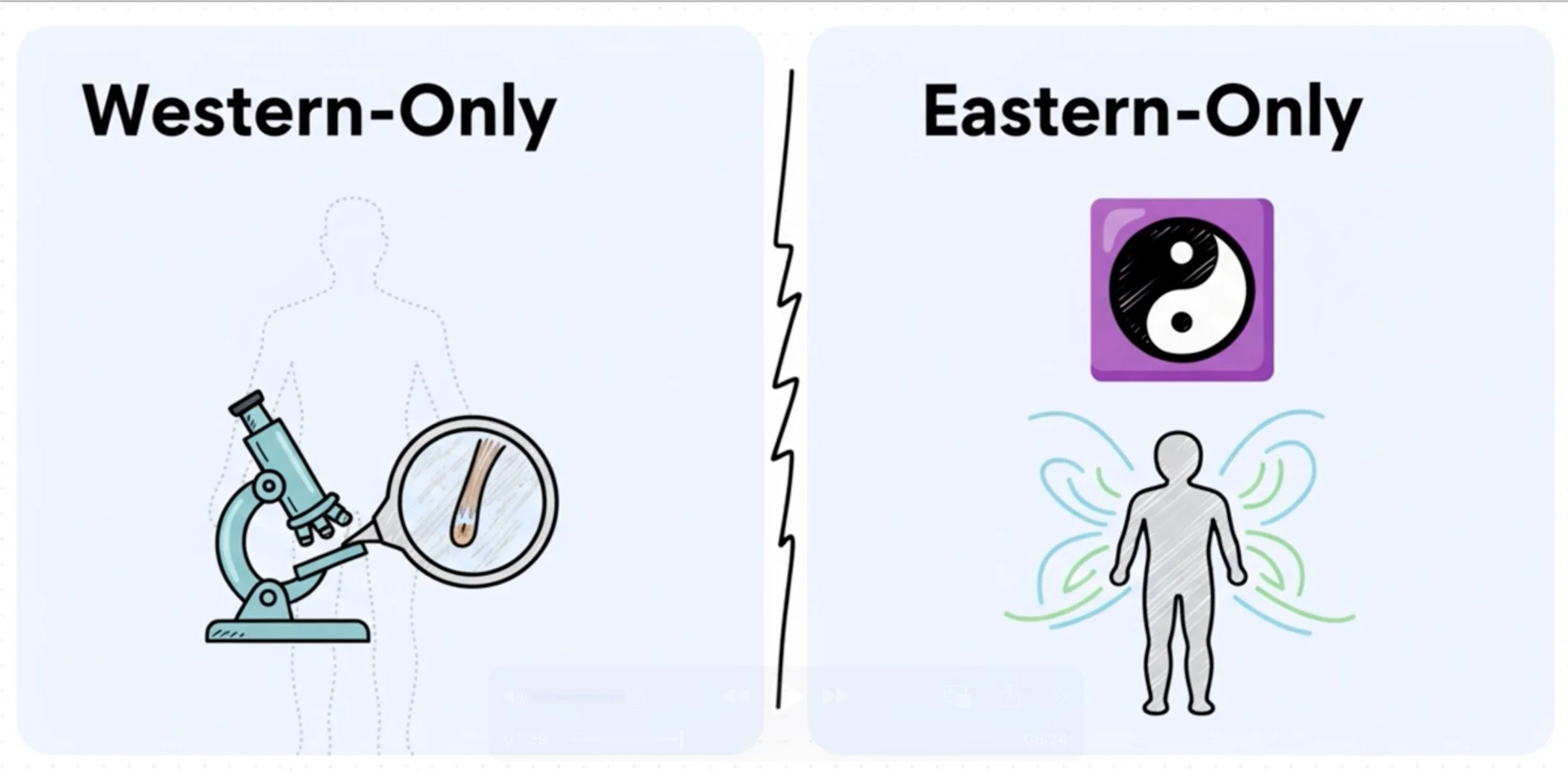
1:03 - The Either/Or Trap: Western vs. Eastern Approaches
2:30 - Integration: Two Languages, Same Body
2:48 - Sinew Channels: Ancient Maps, Modern Validation
3:36 - Trigger Points: Where East Meets West
4:28 - Bi-Directional Illumination Explained
4:59 - Integrated Assessment: Comprehensive Detective Work
5:33 - Treatment That Addresses Multiple Levels
6:04 - The Question: Symptoms or Root Cause?
Why Integration Matters [2:30]
Most athletic injuries aren't just structural problems OR just energetic imbalances - they're both simultaneously. Your VMO motor point shuts off (Western neuromuscular dysfunction) because your Spleen channel is depleted (Eastern energetic deficiency). This is why isolated approaches keep missing something.
Western sports medicine brings motor point precision and orthopedic testing to identify WHAT is injured
Traditional Chinese Medicine provides channel theory and Qi/Blood framework to understand WHY you were vulnerable
Integration addresses local tissue dysfunction AND systemic patterns simultaneously
The result: treatment that stops the recurring injury cycle instead of just managing symptoms
The shift: From "either precise OR holistic" to "both precise AND holistic."
Ancient Wisdom Validated by Modern Science [2:48]
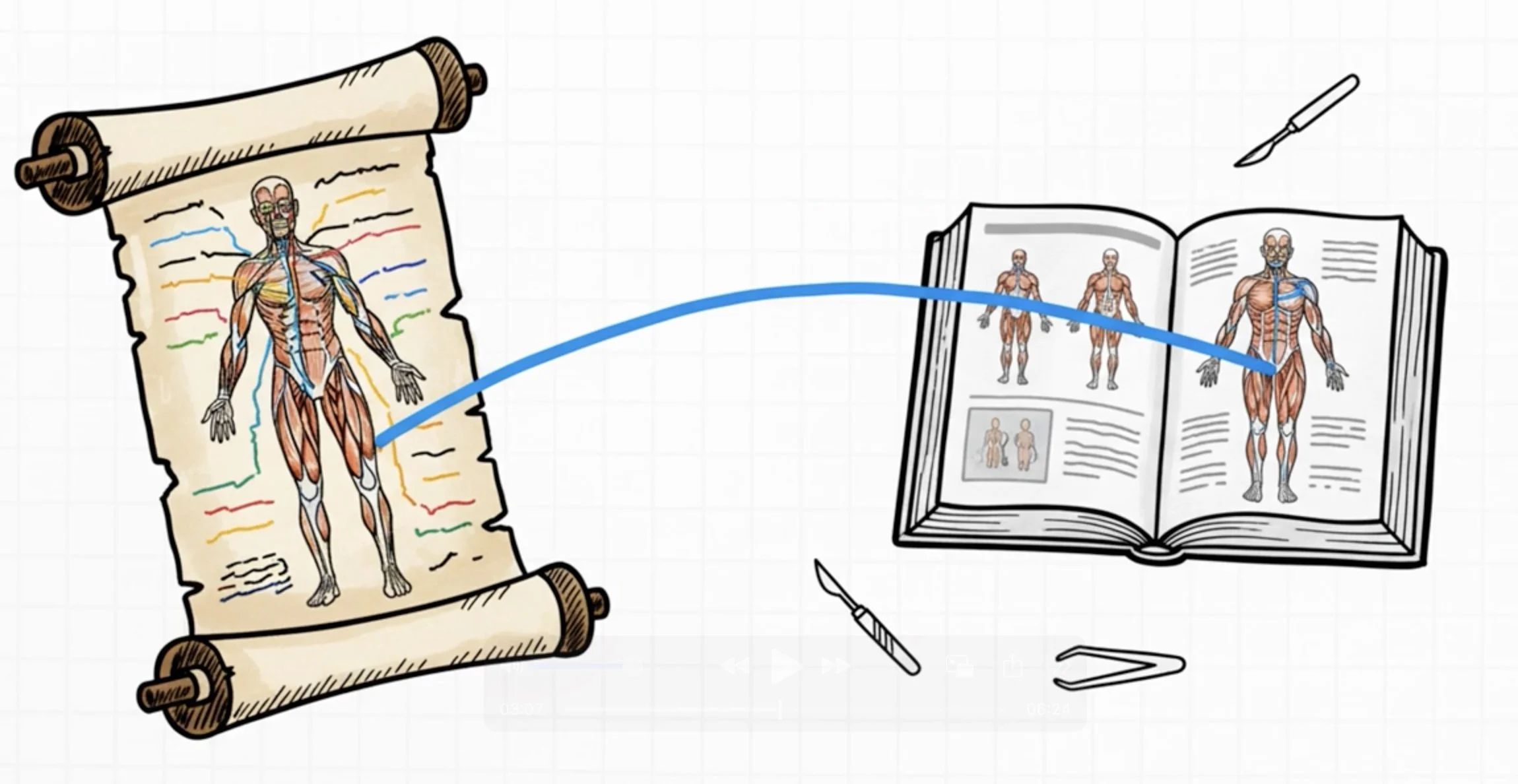
Two thousand years ago, Chinese medicine mapped continuous pathways of muscles, tendons, and fascia called sinew channels. Modern research studying human cadavers discovered the exact same pathways and called them myofascial meridians. The overlap? An incredible 89%.
Sinew channels (Jing Jin) = ancient maps of muscular pathways developed through clinical observation
Myofascial meridians (Anatomy Trains) = modern fascial planes identified through cadaver dissection
They're the same anatomical structures, discovered independently by two traditions millennia apart
Trigger points show 93.3% correspondence with classical acupuncture points (statistical probability of coincidence: 1 in 7 trillion)
The validation: Ancient empirical wisdom now has modern anatomical confirmation.
Bi-Directional Illumination [4:28]
Safety protocols work best when patients feel empowered to ask questions. Here's what you should feel comfortable asking.
Patients should feel empowered to ask about safety protocols
Practitioners should be willing to show the sealed package and explain the safety measures
A good practitioner welcomes these questions. If asking about safety feels uncomfortable, that's a red flag.
What Integrated Assessment Reveals [4:59]
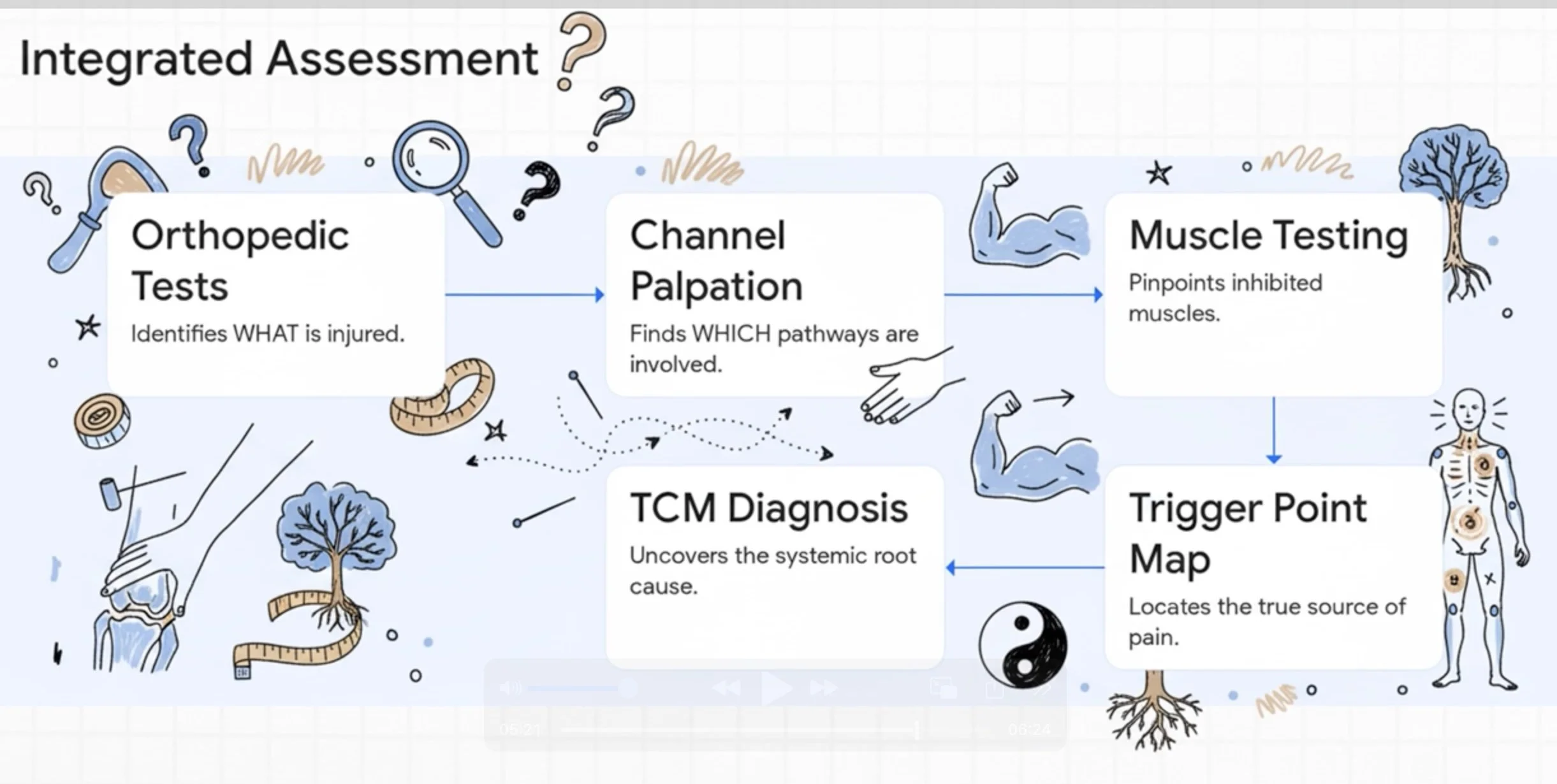
Before any needles go in, sports medicine acupuncture combines Western orthopedic testing with Eastern channel diagnosis to understand your complete injury pattern. This detective work reveals connections that isolated approaches miss.
Western tests identify injured structures, weak muscles, restricted movement patterns
Eastern channel palpation reveals which pathways are excess (tight, stagnant) vs. deficient (weak, depleted)
Manual muscle testing shows motor control dysfunction
Trigger point mapping reproduces your exact pain by pressing specific spots
TCM diagnosis connects everything to systemic root causes (Qi depletion, Blood stasis, organ patterns)
The integration: Treatment addresses neuromuscular dysfunction, fascial restrictions, channel imbalance, and constitutional patterns simultaneously. Every needle serves both anatomical precision AND energetic purpose.
Sports Medicine Acupuncture San Diego: What Makes It Different from Traditional Acupuncture and Western Sports Medicine
As an endurance athlete, you know the frustrating cycle. You get an injury—that familiar runner's knee or nagging IT band tightness—and you do all the right things. You try physical therapy, diligently strengthening the weak muscles. You get massages to release the tight tissue. You might even try traditional acupuncture for pain relief. Each one helps, for a while. The pain gets better, but then it comes back at mile 8 of your long run, or the tightness returns a few days after the massage.
Each of these approaches is valuable and effective for what it does. Physical therapy excels at restoring motor control, massage is fantastic for mechanical tissue release, and traditional acupuncture is powerful for balancing the body's systemic energy. Yet, when used in isolation, they often miss a key piece of the puzzle. They address a symptom or a single component of the problem, but not the complete, interconnected picture that led to the injury in the first place.
This is where sports medicine acupuncture comes in. This integrated approach isn't about using Eastern and Western medicine "side-by-side," but a genuine synthesis where each tradition enhances and illuminates the other. For athletes in San Diego seeking sports medicine acupuncture, this means a more comprehensive treatment that addresses both the specific anatomical issue and the underlying energetic pattern that allows an injury to keep returning. This post will break down exactly what makes sports medicine acupuncture different, exploring the scientific validation for this approach, how it changes assessment, and how it treats the complete picture.
What Sports Medicine Acupuncture Is—and How It Differs from Traditional Approaches
At its core, sports medicine acupuncture is a fusion of Traditional Chinese Medicine (TCM) with Western sports medicine methodologies. It isn't a practice where you get a little of one and a little of the other; it's a single, cohesive system where ancient wisdom provides the framework and modern science provides the anatomical precision.
The key distinction is its ability to treat tissue dysfunction and energetic imbalance simultaneously. This genuine integration allows for a more complete diagnosis and treatment that addresses both the local injury and the systemic vulnerability behind it. Here's what each tradition brings:
Western Sports Medicine Contributions:
Motor Point Anatomy
Trigger Point Mapping
Orthopedic Testing
Biomechanical Analysis
Traditional Chinese Medicine Contributions:
Channel Theory
The Qi/Blood Framework
Sinew Channels (Myofascial Pathways)
Systemic Zang Fu (Organ) Pattern Diagnosis
By weaving these elements together, sports medicine acupuncture addresses the injury on multiple levels. It can reset a dysfunctional muscle at its exact neuromuscular junction while also treating the systemic energy deficiency that caused that muscle to shut off in the first place.
The Scientific Validation: Where Ancient Wisdom Meets Modern Research
One of the most compelling aspects of sports medicine acupuncture is how modern research has validated the anatomical maps discovered by ancient Chinese physicians thousands of years ago. This isn't a mystical or metaphorical connection—it's a statistically significant anatomical reality.
89% Overlap: Ancient Chinese sinew channels—pathways of muscle, tendon, and fascia—have an 89% overlap with modern myofascial meridians described in Tom Myers' Anatomy Trains.
93.3% Overlap: Ancient Chinese Ashi points (tender points discovered through palpation) have a 93.3% overlap with modern Western trigger points, which were mapped in the 1950s.
The statistical probability of this overlap being a coincidence is approximately 1 in 7 trillion. The key takeaway is profound: two different medical traditions, separated by thousands of years and hemispheres, independently discovered the same anatomical realities. This confirms that sports medicine acupuncture is an evidence-based practice grounded in precise anatomical and neurological principles, not vague energy work.
How Sports Medicine Acupuncture Assessment Works: A Different Kind of Detective Work
The power of this approach begins with an assessment that's far more comprehensive than what you'd find in isolated practices. In my San Diego sports medicine acupuncture practice, I combine Western orthopedic evaluation with Eastern channel diagnosis to create a complete picture.
"Before any needles go in, I'm doing detective work combining both systems..."
This "detective work" isn't just a checklist—it's a process of synthesis that reveals connections isolated approaches miss. For example, an assessment for runner's knee goes beyond simple testing. Manual muscle testing might show a weak VMO (a Western finding). That immediately prompts me to check the Spleen channel, which runs directly through it (an Eastern map). I'll then palpate that channel, ask about your energy and digestion (which the Spleen governs in TCM), and suddenly we understand it's not just a "weak muscle"—it's a motor point inhibited because the energetic pathway feeding it is depleted.
This integrated assessment includes:
Western orthopedic tests to identify injured structures
Eastern channel palpation to reveal which pathways are excess or deficient
Manual muscle testing to assess motor control dysfunction
Trigger point mapping to locate referred pain sources
TCM pattern diagnosis to understand systemic root causes
The result connects your local pain, your motor control, and your systemic energy into a single, cohesive picture that guides precise treatment.
Bi-Directional Illumination: How Each Tradition Makes the Other More Powerful
The relationship between Eastern and Western perspectives in sports medicine acupuncture is best described as "two languages describing the same body." One isn't better than the other—they're simply different vocabularies for the same anatomical and physiological reality.
Before I studied this synthesis, I thought acupuncture was either vague energy balancing or precise anatomical needling. What I learned is it's BOTH simultaneously. The channels aren't abstract—they're anatomical pathways. The motor points aren't random—they lie on channels.
Each tradition illuminates and enhances the other:
Eastern Wisdom Leads to Western Precision: Channel theory provides the roadmap. A diagnosis of "Spleen channel deficiency," which runs along the inner leg, tells us the VMO (vastus medialis oblique) motor point, which lies on that channel, needs activation. The ancient map leads directly to the precise modern target.
Western Research Validates Eastern Concepts: Modern research into fascia confirms that the ancient sinew channels are not abstract energy lines but real, physical structures. The Gallbladder sinew channel, for instance, corresponds directly to the myofascial plane that includes the IT band. A TCM diagnosis of "Gallbladder channel excess" is another way of describing the anatomical reality of IT band tightness and the presence of trigger points.
I explain this integration in more detail in this video, showing how Eastern wisdom and Western precision enhance each other:
Sports Medicine Acupuncture Treatment: Combining Motor Points, Trigger Points, and Channels
An integrated sports medicine acupuncture treatment session addresses the injury on multiple levels simultaneously. A typical treatment in my San Diego practice combines four primary needling techniques, each with a specific purpose.
1. Motor Point Needling: This targets the exact neuromuscular junction where the nerve enters the muscle. Often performed with electrical stimulation (e-stim), this technique elicits a local twitch response that effectively "reboots" the nervous system to restore proper muscle function.
2. Trigger Point Release: This addresses the hyperirritable knots in muscle tissue that create referred pain patterns. Releasing these Ashi points can immediately alleviate pain and resolve fascial restrictions that contribute to dysfunction.
3. Channel Point Selection: Using classical acupuncture points, this technique balances the body's overall energy system. It involves "tonifying" (strengthening) deficient energy pathways and "sedating" (calming) excess ones to address the root energetic imbalance.
4. Sinew Channel Treatment: This focuses on restoring balanced movement patterns along entire myofascial chains by releasing "locked-short" tissues (contracted, tight, restricted) and strengthening "locked-long" ones (overstretched, weak, inhibited).
To make this concrete, consider a case of runner's knee. A single sports medicine acupuncture session might include activating the VMO motor point with e-stim, releasing IT band trigger points, tonifying the Spleen channel to address medial weakness, and sedating the Gallbladder channel to resolve lateral tightness. Every needle serves both a precise anatomical target and a broader energetic purpose.
Why Sports Medicine Acupuncture Is Different From the Treatments You've Already Tried
If you've been stuck in a cycle of recurring injuries, it's because the treatments you've tried only addressed one part of the problem. Sports medicine acupuncture is different because it targets the entire pattern, leading to permanent solutions instead of temporary relief.
Different from Physical Therapy Alone: PT is excellent for strengthening weak muscles, but sports medicine acupuncture asks why that muscle shut off. Often, the answer is an underlying channel deficiency or Qi stagnation that inhibits motor function. This integrated approach treats that energetic root cause, allowing the strengthening to actually hold.
Different from Massage Alone: Massage provides mechanical release of tight tissues. Sports medicine acupuncture goes deeper by clearing the energetic stagnation that causes the tissue to tighten in the first place and resets the nervous system at the motor point for a more lasting change.
Different from Traditional Acupuncture Alone: Traditional acupuncture is powerful for systemic balance. Sports medicine acupuncture incorporates the anatomical precision of motor point needling and Western orthopedic testing to target the specific biomechanical dysfunctions that athletes face.
"In my San Diego practice, I see this pattern constantly: athletes who've done everything 'right' by Western standards... but the injury keeps coming back. What's missing is the energetic pattern."
Why 'Runner's Knee' Isn't Just 'Runner's Knee': Individual Patterns Matter
No two injuries are identical, even if they share the same name. Your unique training history, past injuries, biomechanics, and constitutional tendencies create a specific pattern that requires a customized treatment plan.
Consider two runners who both present with "runner's knee." An integrated sports medicine acupuncture assessment might reveal two completely different underlying causes:
Runner A: Their pattern is driven by Spleen Qi deficiency. This often correlates with fatigue and poor digestion, leading to weak medial stabilizers. Their treatment will focus on tonification and strengthening the Spleen channel systemically.
Runner B: Their pattern is driven by Gallbladder channel excess. This often correlates with tension and irritability, creating intense lateral tightness. Their treatment will focus on releasing fascial restrictions and sedating this channel to restore balance.
Both have the same diagnosis, but their path to healing is entirely different. The comprehensive assessment is what uncovers an individual's specific pattern, leading to a treatment plan that is tailored, precise, and effective.
A Genuinely Integrated Path to Healing
Sports medicine acupuncture represents a genuine synthesis of Western anatomical precision and Eastern systemic wisdom, a combination validated by modern scientific research. It's not one system layered on top of another, but a truly integrated model where each perspective makes the other more effective.
For athletes stuck in a frustrating cycle of recurring injuries, this approach often provides the missing piece. By addressing the complete picture—the dysfunctional tissue, the faulty motor control, the channel imbalances, and the systemic vulnerabilities—it offers a path to not just manage symptoms, but to resolve the underlying pattern for good.
If your recurring injuries haven't responded to isolated approaches, a comprehensive sports medicine acupuncture assessment may reveal what's been overlooked. For athletes seeking sports medicine acupuncture in San Diego, this integrated framework offers a deeper understanding of your body and a more permanent solution.
I offer complimentary 15-minute assessments at my San Diego practice where we can discuss your specific injury pattern, training history, and goals. This assessment combines Western orthopedic testing with Eastern channel diagnosis to understand what's happening in your unique body.
Ready to explore your specific pattern?
Attribution:
This content was created with AI assistance (Claude AI & Google NotebookLM) and inspired by comprehensive research on sports medicine acupuncture methodology, the integration of Traditional Chinese Medicine and Western sports science, and clinical observations from treating endurance athletes. All clinical insights and Eastern medicine perspectives are from Michael Cohen, LAc, practicing sports medicine acupuncture in San Diego at Funktion Acupuncture.
Disclaimer:
This content is for educational purposes only and is not medical advice. Individual results vary. Always consult qualified healthcare practitioners about your specific situation.